
To Avoid Drowning, Become the Ocean
To Avoid Drowning, Become the Ocean
Sam Hamilton
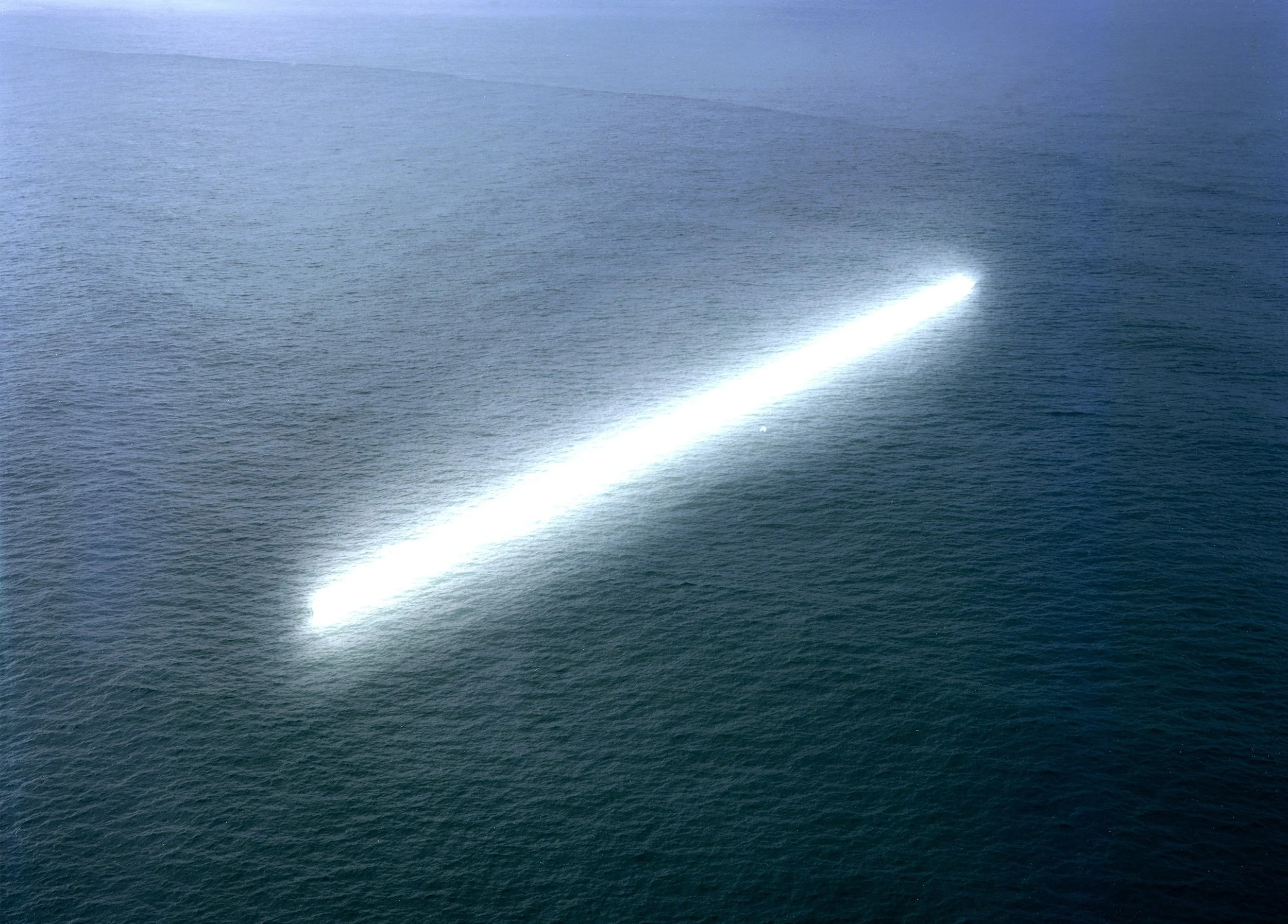
Some forms of change become visible only through time //
What appears distant may already be moving through us
Rebecca Solnit writes that "the beginning comes after the end." Within that proposition is the possibility that transformation does not arrive all at once, but emerges through our willingness to remain attentive to what is already unfolding around us.
In To Avoid Drowning, Become the Ocean, Sam Hamilton creates space for a different kind of attention. The exhibition takes its title as a proposition: that survival may depend less on resisting the forces around us than on recognizing our place within them. Across sound, video, sculpture, and light, the works invite visitors to slow down and remain with experiences that resist immediate resolution. Meaning accumulates gradually through repetition, duration, and sustained listening.
At the center of the exhibition is the titular work, To Avoid Drowning, Become The Ocean (2026), a multichannel sound installation developed through a series of recordings with community members from St. Louis, Missouri and Portland, Oregon. Through bubbling, humming, whooshing, and shushing, voices gather into an evolving soundscape that echoes the movement of the ocean. Individual voices emerge and recede within the larger composition, creating a work that depends on collective presence. Together, these recordings amplify a voice that is difficult, if not impossible, to create alone.
Presented as a series of three medium-format photographs, The Session Always Outlives The Solo (2026) documents a private performance beneath a waterfall. Water collapses onto a drum kit, striking cymbals and generating sound through its own movement. The resulting images capture an encounter in which authorship becomes difficult to locate, as the boundaries between performer, instrument, and environment begin to dissolve.
Mid-revolution (2024) is a motor-driven light sculpture suspended from the ceiling that completes a single rotation every two hours. Though its movement is nearly imperceptible, the work gradually alters the atmosphere of the gallery, rewarding sustained attention and reminding us that some forms of change become visible only through time.
Throughout the exhibition, the ocean functions as a model of relation, reminding us that no body, action, or experience exists in isolation. Rather than presenting certainty or conclusion, these works ask what becomes possible when we understand ourselves as part of larger currents of interdependence and change, and give ourselves the time to listen closely.
The works in this exhibition reward patience rather than certainty. They ask us to remain with what is unfinished, unresolved, and still becoming. In doing so, Hamilton offers a reminder that uncertainty is not simply something to endure, but a condition through which new forms of relation emerge and new possibilities begin to take shape.
We invite you to spend time with the work, take a seat, and stay awhile. Additional materials related to the exhibition, including Solnit’s publication, are available in the gallery and bookstore.
About the Artist
Sam Hamilton is a working-class interdisciplinary artist from Aotearoa, New Zealand, of Pākehā (English settler colonial) descent, who immigrated to Portland, Oregon (so-called US) in 2014.
After two decades of full-time practice across multiple fields and global regions, Hamilton's practice today resembles an ecology more than a discipline—a garden of fertile hybridisation, rhizomatic inquiry, and verdant displays of seasonal emergence. In blending political criticality with a playful and humane sensibility, and maintaining a tensioned balance between structure and messiness, and determination and ambiguity, Hamilton’s work often ties together the simple with the complex. Whether taking form as opera, painting, sound installation, photography, artist cinema, writing, ceramics, civic works, or social practice, Hamilton’s work has always been informed by the belief that art is a powerful critical modality through which real human cultural and material prosperity can be realised. And that the artist has an inherent responsibility to make good on that potential.
Hamilton’s work has been recognized by Creative Capital, The Ford Family Foundation Hallie Ford Fellowship of the Visual Arts, The Oregon Arts Commission Visual Arts Fellowship, Oregon Community Foundation’s Creative Heights award, and the New Zealand Art Foundation New Generation Artist Award.
Acknowledgements
This exhibition is collaboratively curated by the artist and Kalaija Mallery, Artistic & Executive Director of The Luminary, with support from Kristina Murray (Gallery Manager), Kevin Harris (Fabrication and Tech), and ashley king (Designer).
A special thank you to Intersect Arts Center for hosting the recording session for To Avoid Drowning, Become the Ocean, and to the many St. Louis community members and singers from the Portland Gay Men's Chorus whose voices helped bring this sound installation to life.
This exhibition is supported by the Ford Family Foundation, the Andy Warhol Foundation for the Visual Arts, the Teiger Foundation, the Ruth Foundation for the Arts, and the Regional Arts Commission of St. Louis.